Command Palette
Search for a command to run...
Based on Over 20,000 Formulations, MIT and Other Researchers Used a Diffusion Model to Plan Material Synthesis and Successfully Prepared a Novel Zeolite Material With a silicon-to-aluminum Ratio As High As 19.

Materials synthesis, a cutting-edge field deeply intertwined with chemistry, physics, and engineering, has always been a core driving force of modern technological innovation. However, the birth of a new material is never a simple realization of a predetermined formula, but rather an uncertain creation that integrates scientific intuition, precise control, and persistent exploration. If this process is likened to cooking, even with the same dish, different chefs, ingredient ratios, processing techniques, and even minute differences in heat will profoundly affect the final flavor; the same is true for materials synthesis—Every choice of parameter and every fine-tuning of conditions can have a huge, even decisive, impact on the material's properties, leading it to different outcomes.
Currently, researchers have used high-throughput computing and data-driven methods to screen millions of materials with potential stability and synthetic potential from a vast number of compounds. This is like a "menu" containing countless rare and exquisite dishes, providing a preliminary answer to the fundamental question of "what to synthesize" in the field of materials synthesis. However, just as cooking relies not only on recipes but also on the preparation process, having only a "menu" without feasible "cooking methods" remains a key bottleneck in materials synthesis. Therefore, how to "cook up" theoretical materials—that is, solving the problem of "how to synthesize"—is a crucial hurdle that current materials research must overcome to move towards practical applications.
In response to the above challenges,A research team from MIT, the Technical University of Munich, and the Polytechnic University of Valencia has innovatively proposed a generative diffusion model called DiffSyn.This model, trained on over 23,000 generative formulations from a literature spanning more than 50 years, can generate possible synthetic routes based on the target zeolite structure and organic template. Its core advantage lies in capturing the "one-to-many" and "multimodal" characteristics of the structure-synthesis relationship in materials, providing researchers with scientific and precise guidance for the material preparation process. Compared to traditional methods using regression models and other generative models, DiffSyn demonstrates significantly superior performance.
During the research, the team demonstrated DiffSyn's ability to predict efficient synthetic pathways for zeolites (a class of crystalline microporous materials that can be widely used in catalysis, adsorption, and ion exchange).Based on its synthetic route, the research team successfully prepared a UFI-type zeolite material. Density functional theory binding energy calculations verified that its silicon-to-aluminum ratio (Si/Al) measured by inductively coupled plasma optical emission spectrometry (ICP) reached as high as 19.0.This superior property is expected to significantly improve the thermal stability of porous materials, laying the foundation for their application in high-temperature and harsh environments.
The related research findings, titled "DiffSyn: a generative diffusion approach to materials synthesis planning," have been published in Nature Computational Science.
Research highlights:
* DiffSyn, trained on 23,961 synthetic recipes from over 50 years of literature, overcomes the limitations of deterministic mapping in traditional regression models.
* Compared with regression models and other deep generative models, DiffSyn achieves the lowest mean absolute error for 10 out of 12 synthetic parameters, demonstrating significant superiority.
* The target material was successfully prepared with a silicon-to-aluminum ratio as high as 19.0, demonstrating the practical value of the DiffSyn model.
Paper address:
https://www.nature.com/articles/s43588-025-00949-9
Follow our official WeChat account and reply "zeolite prediction" in the background to get the complete PDF.
Focusing on zeolite synthesis: Training data spanning 50 years, covering more than 23,000 formulations.
As a profound and successful research achievement in the field of materials synthesis, DiffSyn's greatest characteristic is its focus. The core dataset used for training the DiffSyn model is the ZeoSyn dataset.This is a dataset proposed by the same team, covering 23,961 hydrothermal synthesis routes for zeolites, including 233 zeolite topologies and 921 organic structure-directing agents (OSDAs).The data source is literature on zeolite synthesis spanning over 50 years.
Enhancing Model Capabilities: Based on the generative diffusion model, innovative chemical guidance is introduced.
The path of material synthesis is never unique. As Elton Pan, the first author of this study, said, in reality, there may be different synthesis paths for material structure-synthesis relationships. This paradigm shift requires the structure-synthesis relationship to change from "one-to-one" to "one-to-many".
Base model selection – Generative diffusion model
For machine learning methods, the "one-to-many" relationship between structure and synthesis presents a significant challenge. Researchers must also consider its inverse relationship, the "one-to-many" relationship between synthesis and structure. Similarly, a single formulation may form a mixture of products, i.e., a competing phase, due to the interaction of complex factors such as thermodynamics and kinetics. In addition, there are complex nonlinear interactions between synthesis parameters, requiring methods that can jointly model the probabilistics of multiple synthesis parameters in order to capture the relationships between variables and to weigh the synthesis parameters.
Prior to DiffSyn, traditional machine learning-based methods primarily employed regression models. These methods deterministically mapped a certain representation of a material to synthesis parameters, directly resulting in a one-to-one structure-synthesis relationship. More importantly, the relationships between the synthesis parameters were independent, failing to express the strong coupling between them. These limitations significantly restricted the predictive accuracy of the regression models.
In contrast, the DiffSyn model takes a completely new approach, based on a generative diffusion model.Compared to classic generative adversarial networks,The diffusion model removes noise from noisy data through training and can generate diverse outputs;Compared with deep generation methods such as variational autoencoders,The iterative denoising process of the diffusion model endows it with high expressiveness, thereby achieving excellent sample quality and even enabling it to capture the boundaries between competing phases in the synthetic space. This is the core feature that distinguishes this study from previous studies.To borrow the author's words, "This is a paradigm shift, from a one-to-one mapping between structure and composition to a one-to-many mapping."

This is also key to DiffSyn's ability to predict zeolite materials with high-dimensional synthesis space.
Core regulatory mechanism – chemical guidance
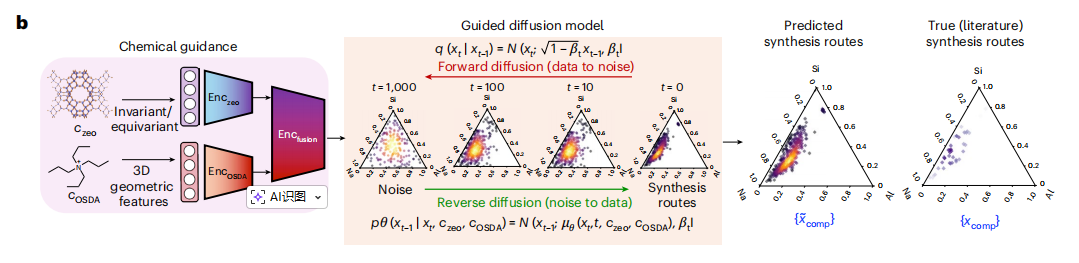
Another key feature of DiffSyn is its "chemical guidance". DiffSyn does not randomly output a set of parameters. Instead, it uses chemical guidance to generate a synthetic route that conforms to chemical principles and targets the target zeolite structure through a diffusion model. Specifically, it uses the target zeolite structure Czeo and the organic structure-directing agent (OSDA) Cosda as input and output. See the figure below:
OSDA is an organic molecule that can "template" the pore structure of zeolites, thereby guiding the synthesis process to form a specific structure, as shown in Figure e below.
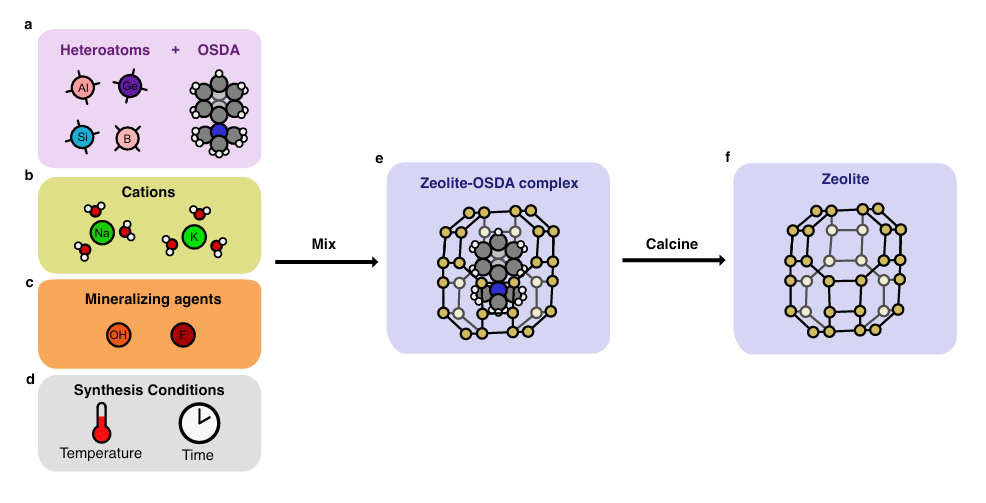
And most importantly,This model does not learn deterministic parameters, but rather conditional probability distributions.Given the target structure and OSDA, a set of synthetic routes is generated, including the gel composition Xcomp and the synthetic conditions Xcond. This is the key to resolving the "one-to-many" relationship mentioned above.
During the training process,The forward diffusion process (the part with red arrows in the workflow diagram) adds Gaussian noise to Xcomp and Xcond, gradually transforming them into a Gaussian distribution.In the inference stage,The backdiffusion process (shown by the green arrow in the workflow diagram) starts with Gaussian noise and uses a classifier-independent guidance strategy to iteratively denoise the noise through a chemically guided U-Net. See the diagram below:
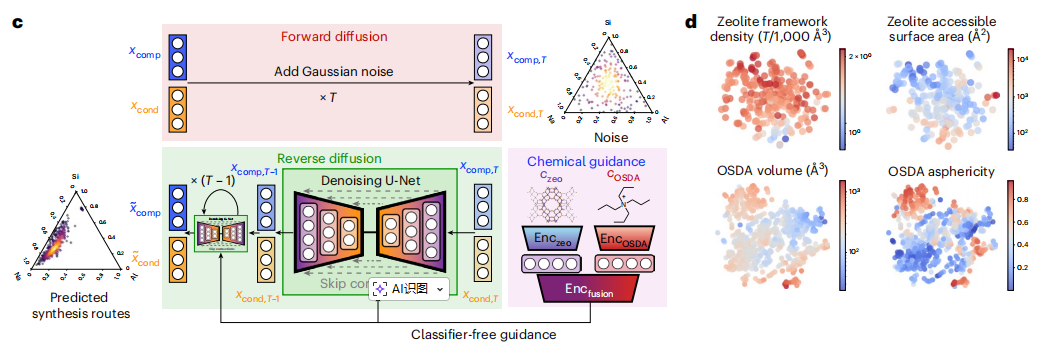
After denoising for T time steps, the model can generate the synthetic route corresponding to the target structure. During the backdiffusion process, the generation metrics such as Wasserstein distance and COV-P (accuracy) are continuously optimized, which verifies the effectiveness of the denoising process and also demonstrates the role of chemical guidance.
Implementation of the DiffSyn workflow – dual encoders, feature fusion encoder
In terms of model architecture,DiffSyn employs a dual encoder architecture, processing the zeolite structure and OSDA through independent encoders (Enczeo and EncOSDA).
To characterize zeolite structures, the research team employed a dual-characterization strategy to extract structural features: invariant geometric features, where the team used the Zeo++ software package to extract relevant physical descriptors from the zeolite structure, such as pore volume, ring size, and maximum enclosing sphere diameter, and then input them into a multilayer perceptron encoder for learning; and equivariant graphical neural network (EGNN) characterization, where the team directly learned chemically meaningful latent space features from zeolite crystal structure spectral data using an equivariant graphical neural network encoder.
* Data sourced from the International Zeolite Association (IZA) database.
For the characterization of organic structure-directing agents, the research team used the RDKit to generate multiple conformations of the organic structure-directing agents and performed gas-phase geometry optimization for each conformation using the MMFF94 force field. Then, they calculated the mean values of the physicochemical descriptors for all conformations, such as molecular volume and two-dimensional shape descriptors, as characteristics of the organic structure-directing agent.
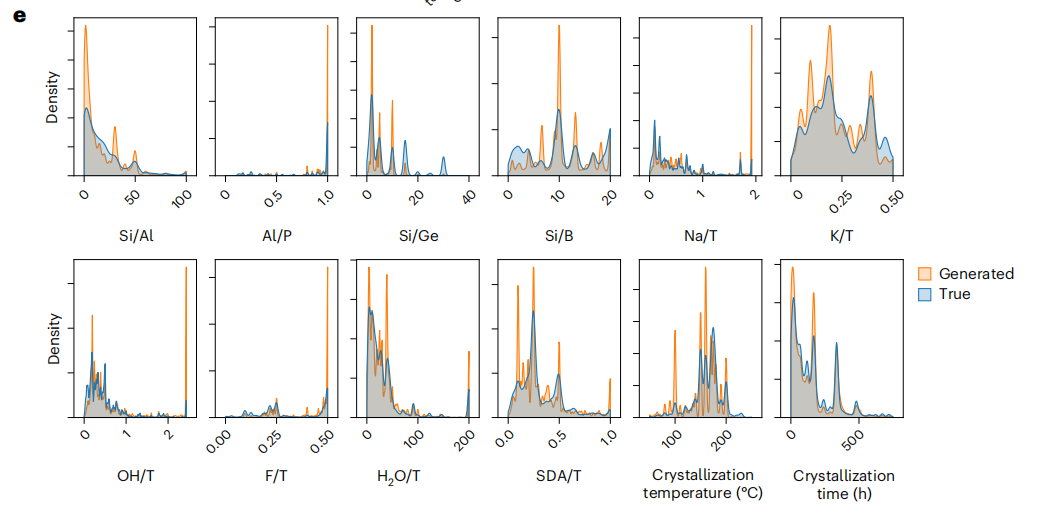
Subsequently, the research team spliced the structural features of zeolite with those of organic structure-directing agents, and then used an Encfusion encoder to learn the joint characterization of both, generating chemical guidance information. This joint characterization is then used to guide the reverse denoising process of the diffusion model, ensuring that the generated synthetic routes conform to chemical principles. Most notably, DiffSyn can generate synthetic parameters that reflect synthetic routes not seen during training but reported in the literature. See the figure below:
Furthermore, classifier-independent guidance is also a key component of DiffSyn. The core principle is to regulate the generation process without adding an additional classifier by weighted combining conditional score functions (containing chemical guidance information) and unconditional score functions (containing no guidance information). In experiments, Puncond = 0.1 and W = 1.0 were found to be optimal, achieving a best balance between the diversity and quality of the generated synthetic routes.
* Puncond is the probability of randomly omitting chemical guidance during training. A value that is too high will lead to excessive restrictions on the generation path, while a value that is too low will reduce the targeting of the target structure.
* W represents the weight of the weighted conditional score during inference, i.e., the guiding strength.
In summary, the above lays an important foundation for ensuring the chemical rationality of the synthetic route for generating the target zeolite material, accurately targeting the target structure, and improving the model's generalization ability.
Multidimensional experimental comparison: Comparative performance reaches state-of-the-art (SOTA), and practical results refresh the highest reported values.
To verify the performance of DiffSyn, the research team set up multiple sets of experiments during the experimental phase, including comparisons with previous methods and comparisons between predicted zeolite synthesis routes and literature reports.
Comparison with regression models and classic generative/deep generative models
The research team established three baseline models to compare with DiffSyn, thereby evaluating the performance and capabilities of the proposed method. The three baseline models are:
* Regression models: AMD (average minimum distance) and BNN (Bayesian neural network)
* Classic generative model: GMM (Gaussian mixture model)
*Deep generative models: GAN (conditional generative adversarial network), NF (normalizing flow), and VAE (variational autoencoder)
The experiment used Wasserstein distance as an indicator to measure the difference between the generated data and the real data distribution, and the coverage index COV-F1 (ranging from 0 to 1, with higher values being better) as an evaluation index of the diversity of generated synthesis routes.
Wasserstein distance demonstrates that deep generative models such as GAN, NF, VAE, and DiffSyn significantly outperform classical methods.DiffSyn improves upon the suboptimal baseline (VAE) by more than 25%.As shown in Figure a below:
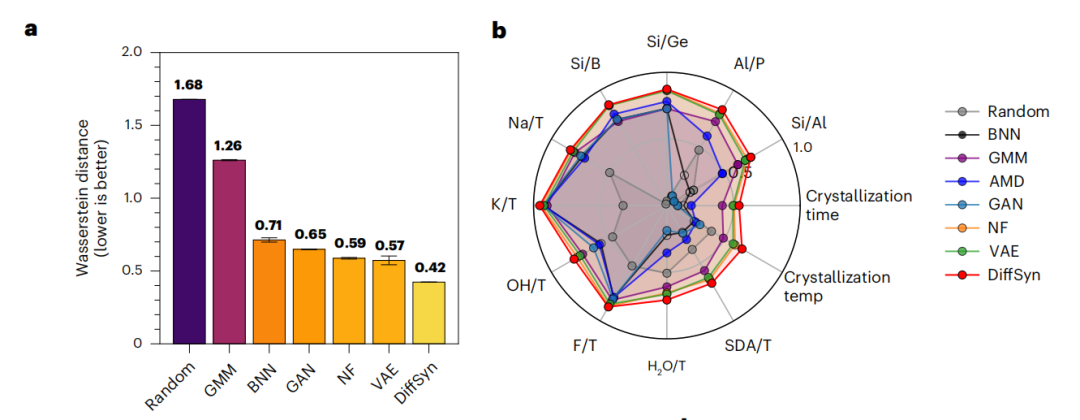
Furthermore, deep generative methods generally outperform regression models, primarily due to their higher COV-R (recall rate). It's worth noting that...DiffSyn outperforms other deep generative models due to its higher COV-P.Furthermore, although DiffSyn is not trained with an explicit mean absolute error target like regression-based methods, it still achieves the lowest mean absolute error for 10 out of 12 synthetic parameters, as shown in Figure c below:
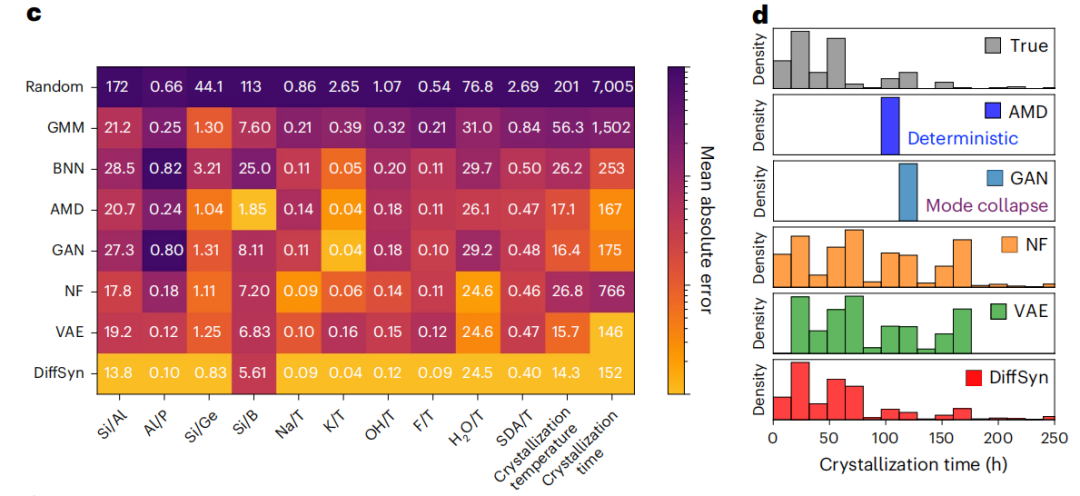
In addition, the research team compared the predicted joint distributions of multiple synthesis parameters using all methods with the actual joint distributions for AEL zeolite.Only deep generation methods can capture the true combined distribution of crystallization temperature and time for this type of crystal structure.Among them, DiffSyn captures the joint distribution most accurately, including most of the real data points (including some outliers), but fails to predict data points (extreme outliers) in the secondary patterns.
In subsequent validation, the research team used DiffSyn to learn the joint distribution of multiple synthesis parameters and examined two synthesis parameters for two previously unseen zeolite-OSDA systems.The results confirm that DiffSyn has mastered the specific rules in the field of materials synthesis.It has significant chemical implications.
Compare the generated synthetic routes with those reported in the literature.
The research team selected several zeolite-OSDA systems with research value and industrial application prospects, compared the differences between the synthetic routes generated by DiffSyn and those reported in the literature, and verified DiffSyn's ability to learn the synthesis-structure relationship for the formation routes of unseen MWW and BEC type zeolites, as well as the FAU/LTA competing crystal phase system. See the figure below:
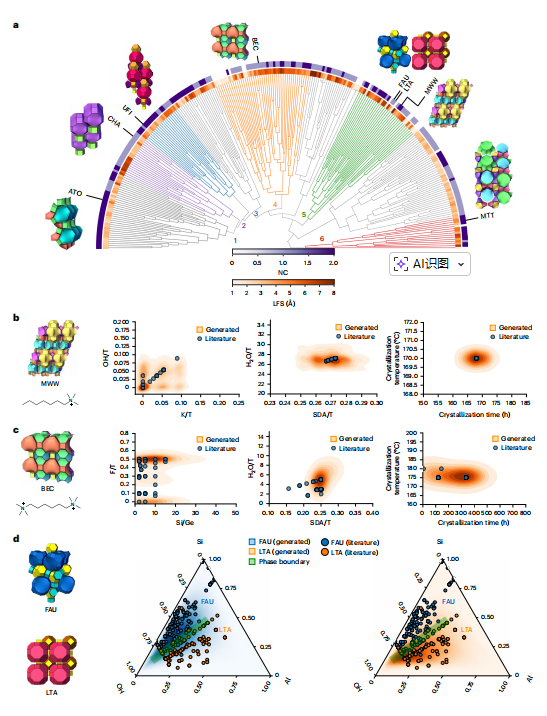
First, regarding the MWW system, it is a two-dimensional structure with a ten-membered ring and a large cavity, which is used in isomerization and aromatization reactions. The OH⁻/T, K⁺/T, H₂O/T, SDA/T, temperature, and time parameters generated by DiffSyn are in high agreement with the actual synthesis parameters.This proves that DiffSyn can still reproduce reasonable windows in unseen structures.
Secondly, regarding the BEC system, it is a macroporous zeolite with a three-dimensional pore topology containing intersecting twelve-membered ring channels, suitable for isomerization and epoxidation reactions. The synthesis parameters Si/Ge, F⁻/T, and temperature/time generated by DiffSyn are highly consistent with those reported in the literature. In particular, the literature points out that Ge and F⁻ stabilize the double four-membered ring (d4r) of the BEC structure during the synthesis process, and DiffSyn does the same.This demonstrates that DiffSyn is able to learn specific heteroatoms, or synthetic conditions, to promote the formation of specific structural units in zeolites.
Finally, the research team used DiffSyn to predict the synthetic routes of FAU and LTA zeolites without OSDA. The synthetic routes generated by DiffSyn were in high agreement with those reported in the literature. Notably,DiffSyn accurately predicted the phase boundary region between FAU and LTA without OSDA, clearly defining the synthesis space for the formation of competing phases.This result shows that DiffSyn can not only accurately capture structure-synthesis relationships, but also reversely resolve the decision boundary of synthesis-structure, thus demonstrating its potential for phase-selective synthesis. It also has high generalization and applicability, and can be applied to a variety of zeolite structures and their corresponding chemical systems.
Verification of the generation of the optimal synthesis route
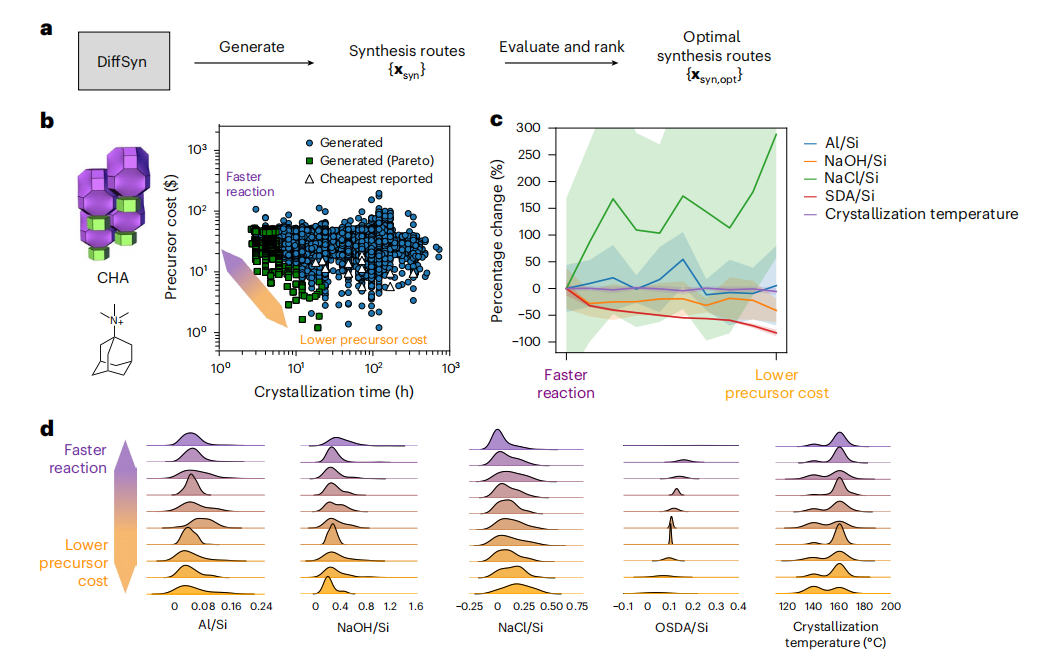
Generating synthesis routes and planning optimal synthesis routes are two dimensions of the same problem. To address this, the research team evaluated DiffSyn's ability to achieve the latter.
The experiment used trimethyladamantium ammonium (TMAda) as an organic structure directing agent to synthesize CHA-type zeolites, generating multiple combination routes and calculating the corresponding precursor costs and crystallization times. See the figure below. The partial Praeto-optimal routes generated by DiffSyn have shorter crystallization times and lower precursor costs compared to the 20 lowest-cost synthetic routes reported in the literature.
at last,The research team experimentally verified the synthetic route of DiffSyn to generate UFI-type zeolites and successfully synthesized four UFI-type zeolite materials.For the synthesis of UFI-type zeolites, the research team chose Kryptofix 222 (K222) as the OSDA because this system did not appear in the training data, which is beneficial for testing the generalization ability of DiffSyn.
DiffSyn generated 1000 synthetic routes, and their distribution lies within the subspace of all reported zeolite route distributions, as shown in the figure below. Furthermore, the study revealed that most competing crystalline phases do not share common composite structural units with the target crystalline phase, confirming the complexity of the structure-synthesis relationship and its inability to be explained solely by structural units.
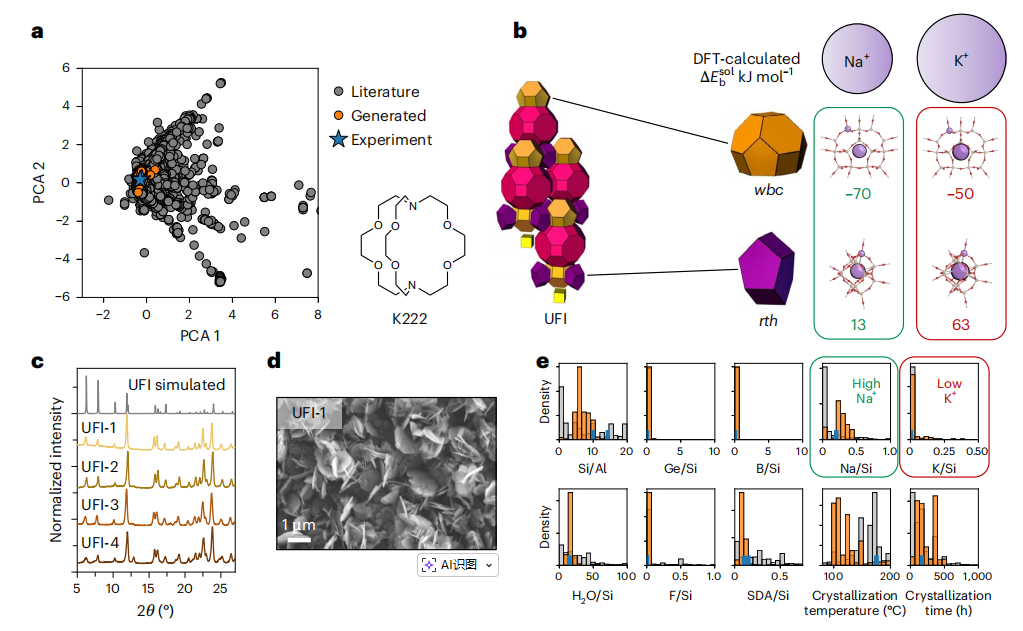
The test results showed that the powder X-ray diffraction pattern of the synthesized sample was in high agreement with the simulated pattern.The obtained crystal was confirmed to be a UFI-type zeolite structure, and the silicon-to-aluminum ratio measured by ICP was as high as 19.0, which is one of the highest values reported in the synthesis of UFI-type zeolites to date.
More importantly, the research team emphasized that collaboration between DiffSyn and human experts is crucial for achieving ideal synthetic results, and they validated this statement using the example of crystallization temperature. In conclusion, the model provides the synthetic route, while human experts use their experience to make corrections and decisions; this may be the key to the future application of artificial intelligence in materials synthesis planning.
This "recipe book" uses a variety of materials to connect "what to synthesize" with "how to synthesize".
The cross-integration of the fields of materials synthesis and artificial intelligence is deepening, which provides an accelerator for the materials synthesis field to move towards intelligence, precision and integration.
First, the vigorous development of artificial intelligence, especially generative artificial intelligence, is accelerating the formation of materials synthesis databases. In particular, in the industry, tech giants such as Google and Meta have invested heavily in generative artificial intelligence, creating a large database of materials synthesis formulas. These formulas theoretically provide fertile ground for materials synthesis and innovation.
Furthermore, relevant databases are constantly being improved and enriched for specific sub-fields, especially with a more focused development in academia and research. For example, prior to this research, the team had already conducted long-term tracking of zeolite materials. Addressing the challenge of the small size and limited number of current public zeolite synthesis databases, they proposed the ZeoSyn dataset—a dataset containing 23,961 hydrothermal synthesis routes for zeolites. Simultaneously, the research also developed a machine learning classifier to predict zeolites given a synthesis route, achieving an accuracy of 70%. This has laid a solid foundation and provided strong theoretical support for the team's further research.
* Paper Title:
ZeoSyn: a comprehensive zeolite synthesis dataset enabling machine-learning rationalization of hydrothermal parameters
* Paper address:https://dspace.mit.edu/handle/1721.1/164092
The material synthesis formula database is like the "menu" in a "recipe." As mentioned earlier, a "menu" alone is insufficient without "cooking methods." The application of regression models, generative models, and diffusion models is akin to researchers' continuous exploration and innovation of a delicious dish. The application of these artificial intelligence technologies is like adding various "cooking methods" to each dish on the "menu," ultimately perfecting the "recipe."
Finally, while the process of material synthesis resembles cooking, it is also vastly different. Compared to ordinary cooking, each successful material synthesis is far more valuable than a uniquely flavorful dish. The birth of each new material may open a door to an unknown world, holding within it the infinite possibilities to drive human civilization and the progress of the times.