Command Palette
Search for a command to run...
A New Method for Predicting Battery Life, Proposed by the University of Michigan and Others, Has Shortened the Verification Cycle by 40 Times, Saving 98% Evaluation Time Through "discovery learning."
Can you imagine a world without batteries? Smartphones, new energy vehicles, and all kinds of smart devices that operate around the clock are built on electrochemical energy storage technology. In other words, batteries are no longer simply energy storage units, but "invisible organs" supporting modern life, industrial development, and technological progress. However, just as living organisms eventually face aging and wear and tear,Batteries can also experience problems such as capacity decay, performance degradation, and unpredictable health status.This has become a core pain point restricting technological innovation and energy transition.
Accurate and efficient prediction of battery cycle life is crucial for the research and large-scale application of next-generation batteries, directly determining their reliability, safety, and total lifecycle cost. However, the path to research in this area is fraught with difficulties:First, there is the high time cost.Predicting a single complete battery lifespan often requires years of dedicated work, which is significantly behind the pace of research and development.Secondly, there is the huge energy cost.Repeated battery prototyping and testing consume a large amount of energy and are accompanied by considerable carbon emissions. If these two major challenges cannot be overcome, not only will the cost of innovation be greatly increased, but battery innovation will also fall into a contradictory "sustainability dilemma"—battery technologies that promote sustainable energy are themselves unable to achieve sustainability in their research and development models.
Against this backdrop, Professor Song Ziyou from the University of Michigan, Ann Arbor, and Jiang Weiran, Vice President of R&D at Farasis Energy, jointly led the project.It innovatively proposes a scientific machine learning method called "Discovery Learning (DL)".Inspired by educational psychology, this method organically integrates active learning, physically constrained learning, and zero-shot learning to construct a human-like closed-loop learning framework for reasoning. Under conservative assumptions, compared to industrial-grade battery life verification processes,Discovery learning enables time savings in evaluation for the 98% and energy savings for the 95%, reducing the validation cycle from approximately 1,333 days to 33 days and energy consumption from 8.523 MWh to 0.468 MWh.
The relevant research findings, titled "Discovery Learning predicts battery cycle life from minimal experiments," have been published in Nature.
Research highlights:
* We propose an innovative scientific machine learning model, DL, which organically integrates active learning, physically constrained learning, and zero-shot learning to construct a human-like closed-loop learning framework for reasoning.
* A degradation dataset containing 123 industrial-grade large-capacity lithium-ion pouch batteries was constructed, filling the gap in public large-capacity battery datasets in battery degradation research.
* Achieved time savings in evaluation for the 98% and energy savings for the 95%, reducing the validation cycle from approximately 1,333 days to 33 days.

Paper address:
https://www.nature.com/articles/s41586-025-09951-7
Follow our official WeChat account and reply "Discover Learning" in the background to get the full PDF.
Construct an industrial-grade battery degradation dataset and a small-capacity public training set.
To verify the effectiveness of the discovery learning method, the research team constructed an industrial-grade battery degradation dataset as a test set, as shown in the figure below:
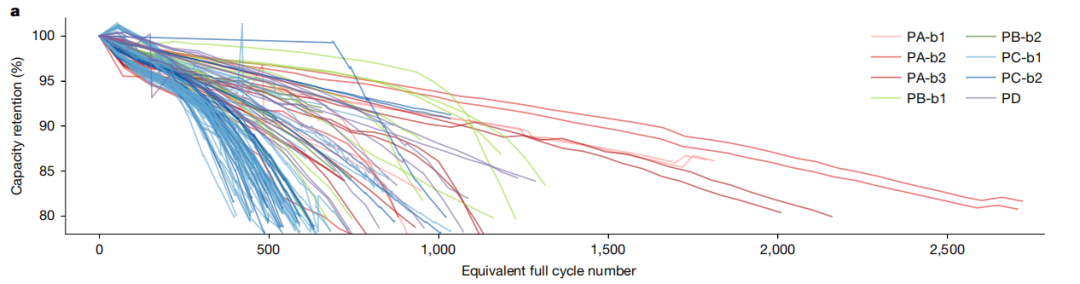
P represents a pouch cell battery, and A represents a custom coding; the cycle life ranges from 250 to 1700 cycles.
This test set contains 123 large lithium-ion pouch cells (73–84 Ah capacity), covering 8 different cell types.These cells utilize different positive and negative electrode materials or battery designs, namely: PA-B1, PA-b2, PA-b3, PB-b1, PB-b2, PC-b1, PC-b2, and PD. Significant design differences exist between the PA (280 Wh kg⁻¹), PB (286 Wh kg⁻¹), PC (286 Wh kg⁻¹), and PD (315 Wh kg⁻¹) cell types, while differences between models within the same batch, such as PB-b1 and PB-b2, are minimal. Furthermore, except for the PD cell, which uses an NMC9 positive electrode (LiNi₀.₉Mn₀.₀₅Co₀.₀₅O₂, nickel atom percentage 90%) and a silicon-carbon (Si-C) composite negative electrode, the other cells are based on an NMC811 positive electrode and a graphite negative electrode.
It is worth mentioning thatCurrently, there is no fully validated large-capacity battery dataset in the industry. The dataset proposed by the research team fills the gap in degradation research datasets.This laid the foundation for further exploration of high-capacity batteries.
To develop an accurate and efficient discovery learning method, the research team constructed a zero-cost public dataset based on small-capacity cylindrical batteries as the training set.
The training set consists of 200 small-capacity cylindrical batteries (1.1–3.5 Ah) from 6 different commercial models.They are A123-M1A (lithium iron phosphate/graphite, 83 Wh kg⁻¹), LG-HG2 (NMC811/SiOₓ–graphite, 246 Wh kg⁻¹), LG-MJ1 (NMC811/Si–C, 255 Wh kg⁻¹), Samsung-25R (NiCoAl–NMC622/Si–C, 216 Wh kg⁻¹), Sony-VTC5A (NCA/SiOₓ–graphite, 196 Wh kg⁻¹), and Sony-VTC6 (NCA/SiOₓ–graphite, 246 Wh kg⁻¹).
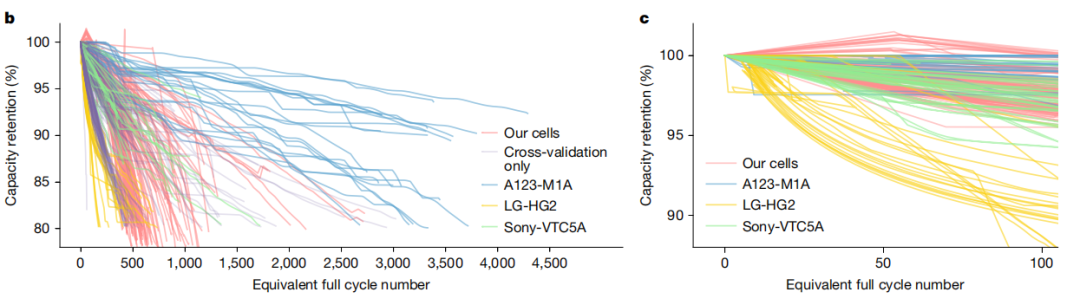
Figure b illustrates the usage of the public dataset; Figure c shows a close-up of the top 50 EFCs (Equivalent Full Cycle Numbers).
During the evaluation phase,The research team divided the 123 batteries into 37 highly consistent experimental groups based on differences in materials, design, and testing conditions.The ultimate prediction target is the average cycle life of each group. Error assessment is conducted at both the individual cell and battery pack levels to comprehensively verify the performance and capability of the method.
Integrating active learning, physically constrained learning, and zero-shot learning
Traditional battery life prediction methods primarily employ two approaches: physical model-based and data-driven methods. While these methods have theoretically offered boundless possibilities, they both suffer from fatal weaknesses in practical applications. For the physical model, the incomplete understanding of battery degradation mechanisms limits its predictive accuracy, hindering long-term breakthroughs. For the data-driven method, extensive training through numerous additional battery degradation experiments is required, and historical data cannot be fully reused. More critically, these methods typically only provide reliable predictions after battery prototype fabrication, creating a significant efficiency bottleneck, particularly when scaling to large-scale design scenarios.
Discovery learning is a flexible and scalable scientific machine learning method that enables rapid and reliable scientific predictions.While ensuring the accuracy and efficiency of the prediction process, it can also minimize the experimental costs required for training and inference.This method benefits from Bruner's discovery learning theory of the 1960s, which posits that the efficiency of human learning and reasoning does not solely rely on direct observation; new inferences can also be derived from prior knowledge and past experience. Therefore, the guiding principle of discovery learning can be interpreted as follows:Reliable predictions are made by learning from zero-cost historical battery data and performing labeled queries on unlabeled test samples.This principle not only greatly reduces the cost of training and inference, but also enables efficient scientific prediction.
In terms of specific implementation methods, in order to organically integrate active learning, physical constraint learning, and zero-shot learning, a closed-loop learning framework for human-like reasoning is constructed.The research team designed three corresponding learning modules and defined three core agents (as shown in the figure below): Learner, Interpreter, and Oracle.
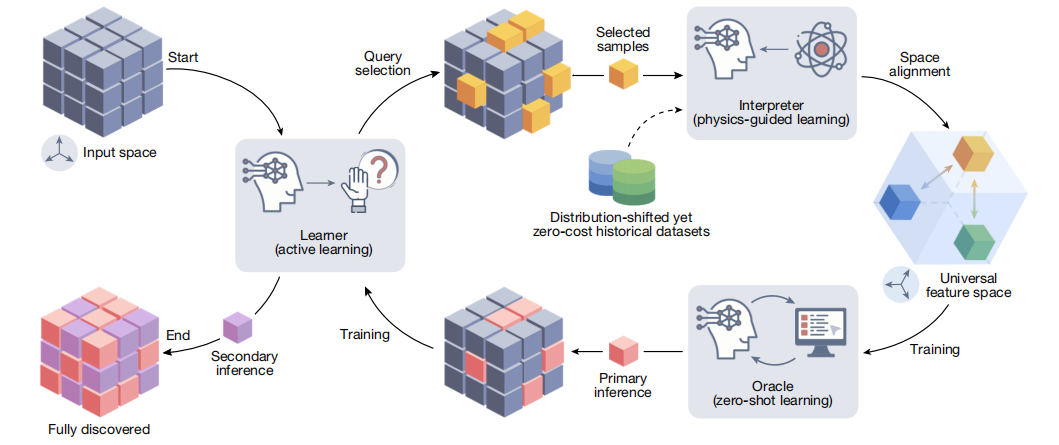
The Interpreter is the executor of physical constraint learning and the foundation for feature construction in discovery learning.The core of this method is to address the feature distribution misalignment between historical and new batteries, transforming battery electrochemical cycling data into a universally interpretable physical feature space, thus providing a unified feature input for subsequent lifetime prediction. Specifically, the interpreter in this method employs simulation-based inference techniques combined with a physical-electrochemical model.
Oracle is designed specifically for zero-shot learning and is the core of initial inference for discovery learning.Its core solution addresses the problem of "excessive data acquisition costs" in battery life prediction, enabling life prediction using only historical battery data without requiring degradation experiments for new battery designs. The research designs a dual-predictor architecture consisting of a basic predictor and a meta-predictor. The basic predictor takes physical characteristics as input and outputs the battery cycle life. The basic predictor is constructed using a linear model combined with an elastic net algorithm; the meta-predictor takes cyclic operating conditions as input and outputs the weight coefficients of each physical characteristic. The meta-predictor is constructed using a support vector regression model.
Learner is the executor of active learning and the core of efficiency optimization for discovery learning.The core objective is to further reduce the cost of experimental inference. By actively selecting samples with the highest information value, the number of battery prototypes requiring physical feature extraction through experiments is reduced, ultimately achieving lifespan prediction for the entire battery design with minimal experimental cost. In this study, Learner's prediction model is based on the Gaussian process regression algorithm, built using the scikit-learn toolkit, and employs both unsupervised and supervised query strategies to select samples.
Specifically,The Learner proactively selects the most informative test samples from the historical battery design dataset. Then, the Interpreter uses physical constraint learning to construct a general and interpretable physical feature space to eliminate the feature distribution differences between historical and unknown batteries. Subsequently, the Oracle performs zero-shot learning, performs preliminary inference on the selected test samples based on the feature space constructed by the Interpreter, and feeds back the inference results as "pseudo-labels" to the Learner.This process is repeated until the preset termination condition is met, thus completing the entire prediction process.
In summary, applying discovery learning methods to predict the cycle life of unknown battery designs eliminates the need for additional degradation experiments for life labeling and significantly reduces the prototype fabrication required to extract early physical characteristics. This provides a new approach for rapid validation of battery life and for providing efficient and accurate feedback to battery designs, accelerating battery innovation and addressing sustainability challenges.
Achieving time savings with the 98% and energy savings with the 95%.
In this study, the research team demonstrated the ability to discover learning based on test sets when predicting the cycle life of novel battery designs with unknown device variability.The mean absolute percentage error (MAPE) of 7.2% can be achieved by using only the data from the first 50 equivalent full charge-discharge cycles of the 51 % battery prototype.Furthermore, this high precision is achieved using a zero-sample approach, surpassing existing mature and representative research results. Under conservative assumptions,Compared to industrial-grade battery life verification processes, discovery learning can achieve time savings in evaluation for the 98% and energy savings for the 95%.
In addition, the research team further evaluated the superiority of the discovery learning method through open-loop and closed-loop prediction experiments.
Open-loop prediction performance
In this experiment, only the open-loop prediction performance of the Interpreter and Oracle is demonstrated; the Learner does not participate in data selection or learning (as shown in the figure below). Under conditions of unknown manufacturing variability,Oracle achieved a group-level mean absolute percentage error of 6.41 TP3T and a root mean square error (RMSE) of 64 cycles in the average cycle life prediction of 37 battery packs.
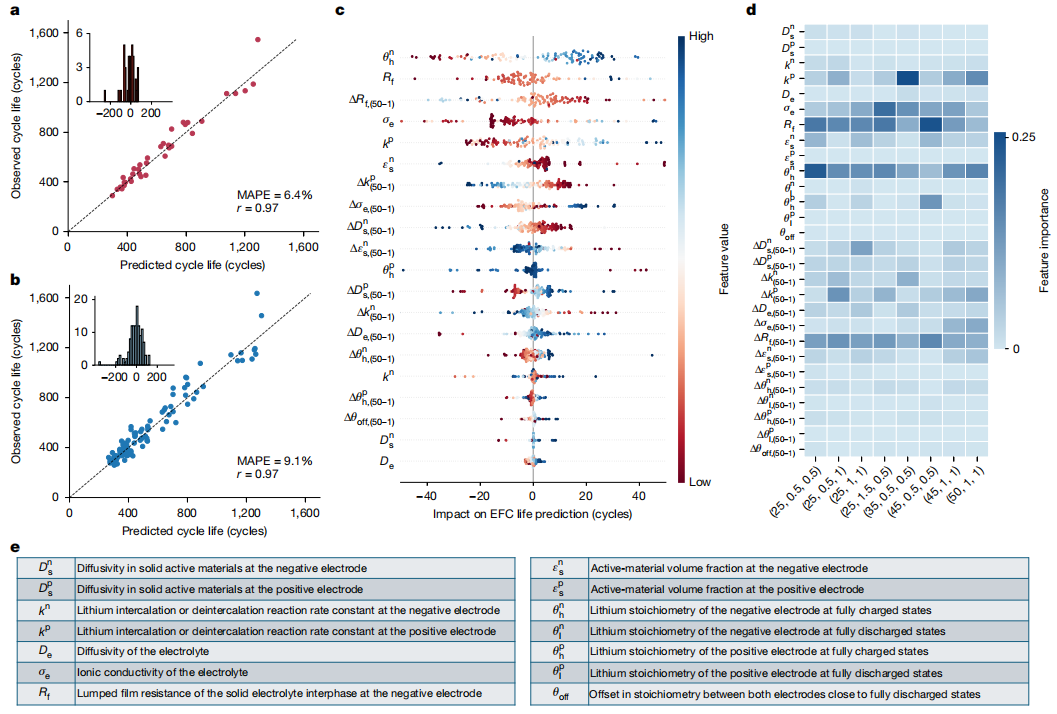
It is worth noting that the battery-level mean absolute percentage error is 9.1%, and the root mean square error is 70 cycles.This indicates that the group-level average absolute percentage error of 6.4% is mainly due to the accurate prediction of 123 individual cells, rather than a coincidence caused by the group-level average.Furthermore, the Pearson correlation coefficient reached 0.97. These results mutually validate the predictive power of the DL method.
Subsequently, the experiment further employed the SHAP (SHapley Additive exPlanations analysis) framework to clarify the relative importance of physical characteristics related to thermodynamic and kinetic features in the early cycling stages (Figures c and e above), thereby identifying the core physical factors that have the greatest impact on battery life. Figure d illustrates the variation of the importance of physical characteristics under different cycling conditions.
Closed-loop prediction performance
This experiment incorporates the Learner module. Learner proactively selects the most informative test samples from 37 battery packs and then performs closed-loop performance prediction.The experimental process is shown in the figure below. It was found that the learning process uses a "pseudo-label" process based on primary inference to replace the experiment-based labeling process in active learning, which further reduces the experimental requirements.
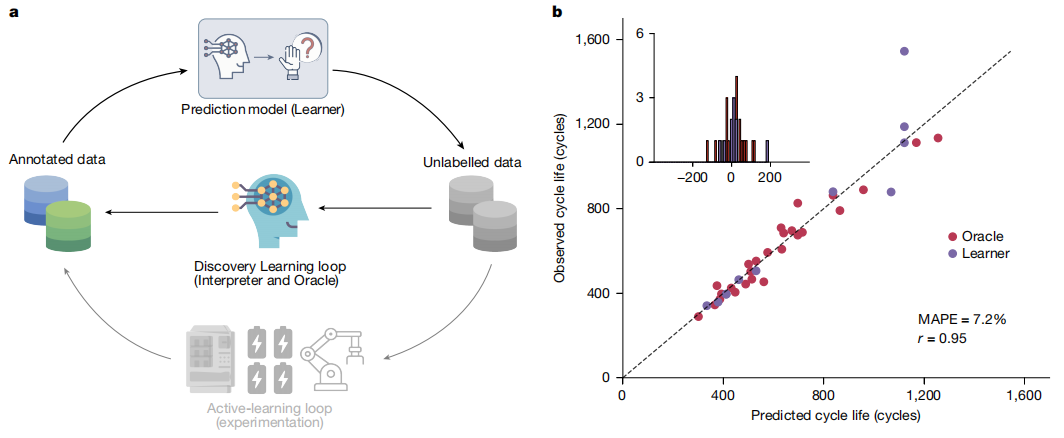
Ultimately, when predicting the average cycle life of the 37 battery packs,The Oracle and Learner modules, working together, achieved a group-level mean absolute percentage error of 7.21 TP3T, with a root mean square error of 91 cycles.While this result represents an improvement compared to the open-loop experiment, it only provides limited validation of the performance advantages of the closed-loop framework.
all in all,This study confirms that discovery learning can predict battery cycle life and efficiency using historical data and a very small number of experiments.More importantly, besides battery design, this method can be extended to the verification of other battery performance indicators, such as safety, fast charging capability, and battery management, provided suitable historical datasets exist in other fields. It can be said that this research lays a solid theoretical and practical foundation for reducing the cost of battery innovation and accelerating its application.
Close collaboration between industry, academia, and research: AI accelerates battery innovation.
In the era of energy revolution and the pursuit of technological advancement, innovation and breakthroughs in battery technology have long been a key force driving social change. From theoretical exploration in laboratories to practical applications in enterprise production, the deep integration of industry, academia, and research is becoming a powerful engine propelling the battery field forward.
Taking this research as an example, Farasis Energy, as a global integrated energy solutions provider, has already made significant achievements in driving the sustainable development of battery technology through technological innovation. Its product portfolio encompasses various material systems, including high-nickel ternary, lithium iron phosphate, and sodium-ion batteries, as well as various battery types such as liquid and solid-state. This research undoubtedly further implements and deepens the concept of innovation-driven development, and based on this innovative approach, it has the potential to spark a new wave of integration between industry, academia, and research.
For Professor Song Ziyou, a leading figure in this research, it was also an important attempt to put theory into practice. It is understood that...Professor Song Ziyou's research focuses on electric vehicles, energy storage systems, battery modeling and management.He has published over 70 papers in top energy and power journals such as IEEE and Energy, and has repeatedly combined AI with the energy field to propose innovative methods. For example, his robust estimation of lithium-ion battery health status based on convolutional neural networks and random forests, proposed with Heath Hofman, aims to solve the problem of accurate estimation of lithium-ion battery health status. It focuses on the actual scenario of "batteries not being fully charged and discharged" in daily use, such as electric vehicles not being fully charged every time. In this case, traditional methods for estimating battery health are usually inaccurate.
Paper Title:
Robust State of Health Estimation of Lithium-ion Batteries Using Convolutional Neural Network and Random Forest
Paper address:
https://arxiv.org/pdf/2010.10452v1
Besides this research, there have been previous successes in industry-academia-research collaborations in the field of battery innovation, such as the partnership between Hangzhou Dianzi University, Zhejiang University, and Tianneng Battery Group. They combined the characteristics of correlation coefficients and neural networks to propose a battery pack internal short-circuit fault detection algorithm based on Spearman rank correlation combined with a three-channel convolutional bidirectional gated recurrent neural network (TBi-GRU). This method can accurately detect internal short-circuit faults in battery packs, providing a new approach and inspiration for earlier detection of battery pack faults and ensuring battery pack safety.
Paper Title:
An Internal Short Circuit Fault Detecting of Battery Pack Based on Spearman Rank Correlation Combined with Neural Network
Paper address:
https://jeit.ac.cn/en/article/doi/10.11999/JEIT210975
In conclusion, the exemplary deep collaboration between industry, academia, and research in the field of battery innovation has repeatedly and clearly demonstrated that artificial intelligence is no longer an external tool in battery R&D, but rather an internalized core engine driving paradigm shifts in fundamental mechanism discovery, engineering design, and full lifecycle management. In particular, the emergence of innovative methods such as deep learning (DL) is guiding battery R&D away from a high-cost, long-cycle "experimentation and trial-and-error" model towards a new paradigm of "predictive design" driven by the fusion of data and physics. This not only provides a new technological path to solving the "sustainability dilemma" of battery innovation, but also ushers in a new era of deep integration between artificial intelligence and energy science.
References:
1.https://www.nature.com/articles/s41586-025-09951-7
2.https://mp.weixin.qq.com/s/1p5FTWhujytM4Cne6NhFSg
3.https://jeit.ac.cn/en/article/doi/10.11999/JEIT210975
4.https://www.kiphub.com/author/6661bcb287272d556e26f335